
Japanese Comic 001: きみってヘンだね!
¥0 税込
This is the Japanese version. You can download this for free.
For those learning Japanese or English, I hope that comparing both versions will be helpful.
日本語(にほんご)や英語(えいご)を学(まな)んでいる人(ひと)にとって、両方(りょうほう)を比較(ひかく)することが役(やく)に立(た)つことを願って(ねがって)います。
Please note that when there isn’t a similar expression in English and Japanese, I have changed it to a more natural one in each language. To develop more natural conversational skills, not everything is a direct translation between English and Japanese, so please be aware of that.
注意点(ちゅういてん)は、英語(えいご)と日本語(にほんご)で同じ(おなじ)ような表現(ひょうげん)がない場合(ばあい)には、それぞれの言語(げんご)でナチュラルな言(い)い方(かた)にかえています。より自然(しぜん)な会話(かいわ)を身(み)につけるべく、すべてが英語(えいご)と日本語(にほんご)の直訳(ちょくやく)ではないのでご注意(ちゅうい)ください。
English Version
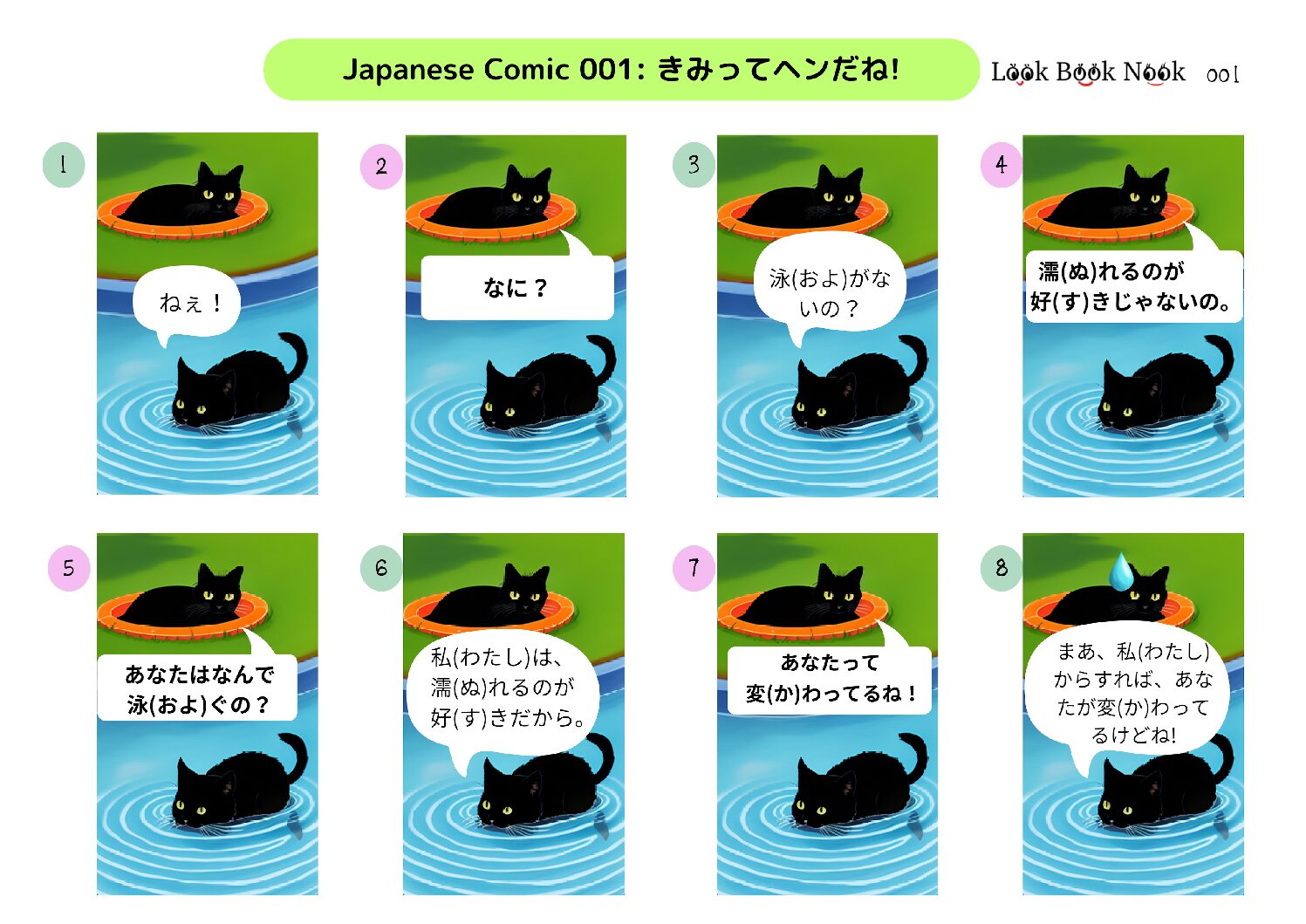
001:You are weird!
1. “Hey!”
2. “What’s up?“
3.”Why don’t you swim?”
4. “I don’t like getting wet.“
5. “Why do you swim?“
6. “I like getting wet.“
7. “You are weird!“
8. “Well, in my opinion, you are the weird one.“
7「あなたって変(か)わっているね。=あなたはかわってるね。=あなたってヘンだね。=きみってかわってるね。=きみってヘンだね。」All of them have the same meaning. どれも同じ(おなじ)意味(いみ)です。
You=あなた=きみ=あんた=おまえ
In everyday conversations, it’s common to call the names or nicknames or omit words like ‘you’. Therefore, in conversations, the use of terms like “あなた,” “きみ,” “おまえ,” or “あんた” is not so frequent.
日常会話(にちじょうかいわ)では名前(なまえ)やニックネーム等(とう)で相手(あいて)を呼ぶ(よぶ)か、省略(しょうりゃく)することが多い(おおい)ので、いずれもそれほど使用(しよう)しません。
「あなた」Polite and can be used for anyone. 丁寧(ていねい)なので、だれにでも使える(つかえる)。
「きみ」For friends or someone of lower status. 友人(ゆうじん)や目下(めした)の人(ひと)に使う(つかう)。
「あんた」「おまえ」Rude, so it’s recommended to avoid using them, especially if you are not familiar with Japanese language customs. 失礼(しつれい)になることが多い(おおい)ので、日本語(にほんご)に慣れない(なれない)うちは使わない(つかわない)ことをおすすめします。
変わっている=変わってる=ヘン=へん=変(へん)【カタカナ、ひらがな、漢字(かんじ)】
Grammatically correct is “変わっている,” but in conversation, it’s often shortened to “変わってる.” ” ヘン, へん, 変” is also commonly used for both things and people. Each of them represents the same meaning, with differences in their writing styles: katakana, hiragana, and kanji, respectively.
文法的(ぶんぽうてき)に正(ただ)しいのは「変(か)わっている」ですが、会話(かいわ)では省略(しょうりゃく)されて「変(か)わってる」もよく使われます。「ヘン、へん、変(へん)」も物(もの)にも人(ひと)にもよくつかわれます。それぞれはカタカナ、ひらがな、漢字(かんじ)という書(か)き方(かた)の違い(ちがい)で、意味(いみ)は同じ(おなじ)です。
Practice makes Perfect! 「練習(れんしゅう)すれば上手(じょうず)になる!継続(けいぞく)は力(ちから)なり!」
以前にこの商品を購入したことのあるログイン済みのユーザーのみレビューを残すことができます。
関連商品
Free Comic Strip
Free Comic Strip
Free Comic Strip
Easy Reads
Free Comic Strip
レビュー
レビューはまだありません。